


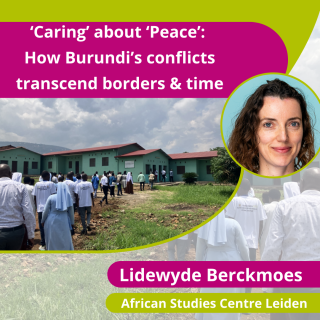
Meet the Expert | Interview with Dr. Lidewyde Berckmoes
Dr. Lidewyde Berckmoes is an associate professor and senior researcher at the African Studies Centre Leiden (ASCL). She also chairs the Researchers Assembly and serves on the board of the ASCL, as well as a Collaborative Research Group Conflict Continuities. Her research focuses on the Great Lakes region in Eastern Africa, mostly centering on Burundi. She studies conflict continuities, or how conflicts transcend borders and time to affect the lives of Burundians both in Burundi and abroad. Her recent work examines the links between conflict and mental health, asking mental health is embedded within society.
Dr. Berckmoes was born in Botswana and has spent part of her younger years in Mali, as her father worked in international development cooperation. Her links to Africa are evident, but Burundi found her by chance. Whilst studying for her Masters in anthropology, she wanted to write her final thesis on the lives of young people coming of age in refugee camps. At the time (2005), not many refugee aid organisations were reachable on the internet yet. Dr. Berckmoes reached out by e-mail to multiple organisations and was eventually invited to a refugee camp in Tanzania, with ‘The Tanganyika Christian Refugee Service’. Here, she met multiple Burundian refugees who had fled the civil war in Burundi (1993-2005). They inspired her to continue exploring the role of young people would be in building lasting peace in Burundi. She followed this up by doing the research master African Studies (right after her graduation in anthropology) in Leiden, followed by a PhD in Amsterdam.
During her postdoc research in 2015, another political crisis erupted in Burundi. The indirectly elected president Pierre Nkurunziza, who came to power in 2005 after the civil war, wanted to run for another, deemed illegal, third term. His political party increasingly silenced its opposition, using increasingly repressive methods.
To understand the dynamics of repeated outbreaks of political violence and war in Burundi, the broader context is essential. Much like Rwanda, Burundi is home to many Hutus and Tutsis. Violence against Tutsi accompanied the struggle for independence in neighbouring Rwanda. In Burundi, political violence occurred too, yet brought a Tutsi president to power. In 1993, external pressure was placed on Burundi to democratise, leading to the appointment of a Hutu president. However, he was assassinated within 100 days, an event followed by an attempted coup by the predominantly Tutsi-army. Civil war ensued, leading to many Hutus and Tutsis fleeing to Burundi.
The ‘Arusha Peace and Reconciliation Agreement’ (signed August 28, 2000), formed a formal pathway to ending the ethnic conflict between the Hutus and Tutsis. In Burundi’s case, this involved 60% Hutu and 40% Tutsi representation in Burundi’s national assembly and parliament, as well as a 50/50 proportional representation in the military and police forces. The agreement led to the eventual forming of a democratic government. Burundi’s constitution is based on the agreement. In 2015, some Burundians feared that the president, and by extension his government, would no longer honour the agreement. This amidst severe economic and other challenges among the population. A political crisis had arrived.
Recently, Dr. Berckmoes and her colleague Marieke Maagdenberg published the book “Traces”. After the Burundian government stifled UN programming around peace in the wake of the 2015 crisis, Dr. Berckmoes noticed little interest in the violent conflict against the population in the Netherlands. The conflict was deemed ‘far away’. She wanted to find a way to engage people with what was happening in Burundi.
Inspired by Héctor Mediavilla’s book S.A.P.E, dr. Berckmoes co-created a visual ethnography – to seduce readers with beauty to take note. The book explores how the present and past of Burundi’s wars shaped thee lives and identity of second-generation Burundians in the Netherlands and Belgium. It impressed her how well these second-generation young Burundians articulated how Burundi’s history shaped their place in the world, and how they sought to inspire positive change despite their relative distance to the country. Dr. Berckmoes hopes the book helps bring attention to the plight of the people of Burundi, humanising the conflict.
Dr. Berckmoes hopes to continue her efforts in redefining what it means to create and maintain peace after conflict. Rather than focusing on “peace”, she argues it makes more sense to focus on “care”. Caring is a verb, whereas peace is a passive, almost idealised state of existence. Caring invites us to take action. Hence, Dr. Berckmoes hopes this approach will inspire a lasting positive change for Burundi, and beyond.
Dr. Lidewyde Berckmoes is a self-declared idealist in heart and soul, and her idealism remains the driving force behind her research.
Interview by Alexander Rhodes, LeidenGlobal
October 2026
Photography: Lidewyde Berckmoes; incl the Opening of the new department of the neuro-psychiatric hospital CNPK in Bujumbura, Burundi. November 2025