

Summary of the LeidenGlobal Dialogues - 26 February 2026
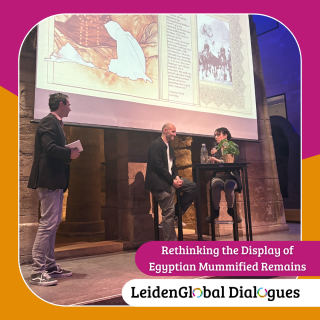
The first edition of our new series ‘LeidenGlobal Dialogues’ was a success. During this dialogue, NINO Visiting Research Fellow Pansee Abou ElAtta and Curator of the Egypt and Nubia collections at the Rijksmuseum van Oudheden (RMO), Daniel Soliman, discussed the tradition of displaying Egyptian mummified remains in museums. Questions such as ‘How might we change the way we discuss and exhibit collections of Ancient Egyptian human remains?’ and ‘Is it possible to better represent the humanity of the dead?’ were central in their discussion. The open dialogue with the audience was moderated by Timo Epping (educator at RMO).
First, Soliman discussed the exact meaning of ‘mummy’. The word ‘mummy’ originated in the 12th century and was derived from the Persian word mūm, meaning ‘wax’. He explained that initially, this word pointed to the obituary practice of mummification, rather than to the whole of the human remains. Over time, this changed to signify the ‘mummy’ as the body.
For the Egyptians, the connotations with the concept of the ‘mummy’ were also very different. In preparing the body for burial, the human remains after mummification were made recognisable: they had a face, a wig, a beard, among other features. The act of wrapping was also very meaningful; the bodies were hidden, which not only points to a state of not being seen, but also to a state of not being fully shed. These people will then emerge in the afterlife with divine-like aspects.
The question remains: how did these remnants end up in museums in the West? The majority of these human remains were forcefully taken from Egypt, a legislative state that enforced its rule on indigenous people. The following treatment of these bodies led to the destruction of multiple mummified remains, for instance, through ‘mummy unwrapping parties'. Colonial practices also decided how these bodies were viewed, which could be very disrespectful and gruesome; the focus was on the material reality instead of cultural stories about the communities these people were from.
Abou ElAtta focused on the histories of the ‘mummy,’ and the conceptualisation of ancient human remains. When the act of preserving bodies during the 12th century came into play, the burial of human remains shifted from a secondary concern of grave robbers to a market of preserving bodies. This also resulted in an increased medical interest; people were interested in mummies in the form of a medicinal powder, named 'mumia'. From the 15th century onwards, trade in mummified remains became punishable, after which the question arose whether the moving of human remains from one place to another violates the dignity and privacy of the dead.
During Napoleon's occupation, Egypt became more accessible to Europeans, leading to a shift in the view of mummified remains toward a more historical and archaeological one. This contributed to the creation of racialised thinking. Later on, the concept of ‘the mummy’ became popularized through Hollywood films and served as a figure of horror. Mummified remains in museums became ‘objects’ to teach people new knowledge, based on the idea that people have no particular opinion about mummies. This, however, leaves no room for alternative ways of thinking about these remains and how they should be understood.
However, the question remains: what would be a better way to discuss ancient Egyptian human remains? According to Abou ElAtta, there are certain aspects that we should move away from. Although some concepts are less prevalent these days, unindividualized and dehumanized bodies go against the autonomy of the people. Soliman added that, even though we do not live in ancient Egypt anymore, there are still ways commemoration can take place in museums. These rituals could help humanise these remains and encourage reflection on the ancient living world.
So, as was asked during the public discussion, why can’t we send these mummified remains back to Egypt and give them a ritualized reburial? As Soliman points out, who is ‘we’ in this instance? And where would ‘we’ send them? For many mummified remains, their origin is unclear, meaning that even if they were sent back to Egypt, there would be no guarantee they would end up at their original burial place. Furthermore, because we are living in modern times, many rituals would not be the same as they were at the moment of burial. The problem of how to treat and handle these human remains would therefore be shifted instead of solved. It is now important to develop new rituals that give these human remains a face and a lived experience.
A ‘good’ way to display and discuss ancient Egyptian bodies remains an important topic of debate. According to Abou ElAtta and Soliman, this already starts with the term ‘mummy’. The figure of ‘the mummy’ needs to be left to Hollywood. Right now, we should reconceptualize the word ‘mummy’ and return to its original meaning: mummified remains.
Written by Fleur van Tellingen, LeidenGlobal intern
February 2026
The LeidenGlobal Dialogues is a collaboration between LeidenGlobal and the National Museum of Antiquities (Rijksmuseum van Oudheden) and is part of the Thursday evening programme at the Rijksmuseum van Oudheden. This pilot edition was created in collaboration with the Netherlands Institute for the Near East.