


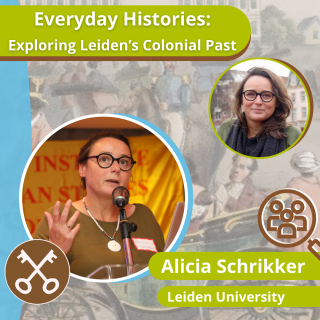
Meet the Expert | Alicia Schrikker
Alicia Schrikker is Director of Research and University Lecturer at the Leiden University Institute for History. She specialises in the history of colonialism in Asia and the Netherlands. Together with colleagues, she studied the modern-day effects and lasting traces of colonialism and slavery in Leiden. In this interview, Alicia discusses her research, activities, and the presence of history in everyday life.
Alicia began her career researching colonial histories in Asia, specifically in Indonesia and Sri Lanka. During her post-doctorate work on colonial governance, she realised that, while important, policy alone did not reflect the experiences of the people subject to colonialism. To get closer to these lived experiences, she has made everyday perspectives a focus in her work (Have a look at Now also in Indonesia). For example, with a team of Sri Lankan and Dutch researchers she examined how Sri Lankans made use of the Dutch East India Company’s (VOC) colonial institutions. By studying documents such as civil court cases, she uncovered how ordinary people spoke about land, each other, and their concerns. While these sources come from the colonial perspective and must be read critically, she notes that they nonetheless make local lives more tangible. Alicia also connects these histories to discussions in the present over contested heritage. In Colombo she has worked with colleagues from the fields of heritage and urban studies to map the deeply layered history of the multi-cultural area Kompannavidiya (also called Slave Island since the time of the Dutch occupation) which has been largely demolished over the past decade.
In recent years, Alicia Schrikker has turned to research projects closer to home; together with Ariadne Schmidt, she supervised preliminary research on the colonial and slavery history in Leiden (conducted by Emma Sow and Sjoerd Ramackers) and Leiden University (conducted by Ligia Giay). This work partly built on an earlier project about the Transvaal neighbourhood undertaken with students. She noticed far more traces of colonial history in the neighbourhood than she, or many other Leiden inhabitants (‘Leidenaren’), had initially realised. It was revealing to learn which histories existed and what current residents knew or thought about them. In the preliminary research, everyday perspectives again played a key role, as researchers asked local parties what aspects of the city’s colonial history they wanted to learn about.
Alicia is glad the Leiden municipality commissioned the study. She explains: “This history may feel distant to some people, as something that happened long ago and far away. Even when reading about history, it can be hard to understand what colonialism meant for people. But realising that the colonial past is present in the city that is the backdrop of your daily life makes it feel closer and more imaginable.”
There is always a certain way of telling history that is familiar. For Leiden, this includes stories about the cloth trade (lakenhandel), Leiden’s liberation day (Leidens Ontzet), the old university, and the 19th-century industry. Colonial history runs through all those stories and is now increasingly recognised as part of Leiden’s past. Alicia hopes it will become integrated into the “commonly known” history of Dutch citizens.
As a result of this preliminary research, the Leiden municipality has formally apologised for its colonial and slavery past on 2 December 2025, and decided to continue research in 2026. In the past few years, Alicia sees more space to study and discuss the Dutch role in colonialism and its lasting effects. She is currently a member of the commission of colonial collections, which advises the government on restitution requests for cultural objects taken in colonial contexts, with the goal of repairing wrongs and injustices. Such activities go beyond acknowledgement to apology and reparation. However, she cautions that awareness and apologies cannot undo the past; when research ends, the issue does not simply disappear. Descendants continue to grapple with the past and its effects. Thus, Alicia Schrikker notes, “We need to move forward together.”
Interview by Shunita Gerritsen, LeidenGlobal Intern
November 2025
Interested in learning about the traces of slavery and colonialism in Leiden? Check out the free Leiden City World Walk Traces of Slavery in Leiden (Dutch)
Have a look at our other experts on the Expert page