


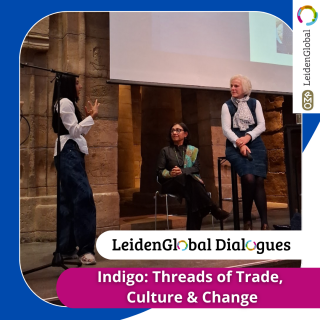
Summary of the LeidenGlobal Dialogues - 21 May 2026
On 21 May, Dr. Aarti Kawlra (International Institute for Asian Studies (IIAS)) and Ms. Elizabeth Visser (Strawberries Fabrics) were invited to share their expertise on Indigo at the 2nd edition of the LeidenGlobal Dialogues.
Indigo is namely not just a colour, it is a defining part of living traditions shaped by people, places and histories. During their discussion, they reflected on questions such as “Is traditional knowledge about indigo truly recognised and valued?”, and “Who owns this knowledge, and why does it matter?” The open dialogue with the audience was moderated by Dr. Priya Swamy (Wereldmuseum).
Kawlra began her presentation by discussing indigo as a global commodity and her relationship with it. Indigo has had a long history, both in colonial and postcolonial times. It was an important product in the trade along the Atlantic, the Caribbean and the Indian Ocean. But what, as Kawlra questioned, of the lived experience of the plant and dye itself? Indigo is not just a product; it had and still has a great impact on the people interacting with it. Everywhere you look, it can be found.
To learn about indigo and its place in the world, it is necessary to facilitate knowledge exchange between disciplinary and community-held knowledge of indigo. And as part of IIAS’ Humanities Across Borders educational research program, scholars, artists, and craftspeople from different geographies did just that to share their knowledge on the dye. In doing so, they collaboratively created educational material that was embedded in these often marginalised lived experiences. So, what can we learn from indigo? Through craft and language, new ways of connecting across borders can be found.
Visser continued this discussion in her presentation. As the owner of Strawberries Fabrics, a retailer of handmade textiles concerned with the preservation of traditional crafts, Visser shared her insights about the way indigo is processed. For each region, the indigo process is different. For example, Asian indigo moves from yellow to green to blue during oxidation of the cloth, while cloth processed in African indigo leaves the pot blue. This also causes colour variations, with African indigo to be a warmer, sometimes purplish kind of blue, and the Asian indigo creating a cooler, brighter colour of blue.
Cloth can also provide insight into the gender dynamics that come into play when indigo is processed and used. As Visser explained, in the Dogon area of Mali (West Africa), the men make the bogolan, a fabric dyed with mud and tree bark, while the women create indigo fabric. The women grow the indigo shrub around the fields and when it’s collected, they form it into bulbs in a tie dye technique. Afterwards, the fabric is put in a pot and when it is taken out, the fabric is coloured blue with a pattern.
Following Visser’s presentation, Swamy began the open discussion by acknowledging the moral dilemma around indigo practices being intimate community knowledge and the impersonal commodification of indigo products. The audience built on that by asking whether there are other ways of documenting this knowledge, and who owns it. Visser explained that the tradition of indigo is still very much alive, but that the recipe is usually a secret.
Kawlra followed up with an example. She explained that after the independence of India, there were only a few dyers left. To not let this craft be lost to history, there was a chemist who was tasked to document this. He travelled to find old pits and dyers and learned the craft. Afterwards, he trained a whole new generation of dyers. Through craft techniques, he was able to pass on community-held knowledge, not just textbook knowledge. These techniques were part of a living tradition, in which still many people knowingly and unknowingly participate now. It is therefore important not only to document these traditions, but also to learn through engaging with them and pass them on to the next generation.
To finish with a quote from the late South Indian master dyer Yellappa: “For indigo to be authentic, one has to have the right soul, the right soil, the right climate, but also the right people to listen, hear and tune in.”
Text & photo by Fleur van Tellingen, LeidenGlobal intern
with contributions by Joaquin Lapuz, IIAS
February 2026
The LeidenGlobal Dialogues is a collaboration between LeidenGlobal and the National Museum of Antiquities (Rijksmuseum van Oudheden) and is part of the Thursday evening programme at the Rijksmuseum van Oudheden. This edition was created in collaboration with the International Institute for Asian Studies (IIAS).