


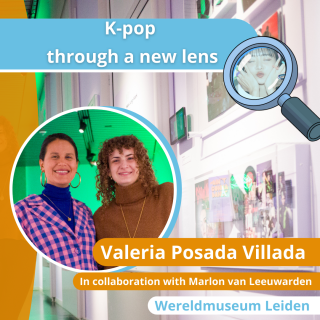
Meet the Expert | Interview with Valeria Posada Villada in collaboration with Marlon van Leeuwarden
Valeria Posada Villada has worked as a curator of photography for the Wereldmuseum Leiden (Worldmuseum) for the past three years. The museum holds an extensive photography collection ranging from 1858 to the present, which aligns with Valeria’s academic background in history and museum studies. However, she also enjoys researching contemporary photographers and current visual culture, particularly searching for what photography means to people today. This interest led to the development of the exhibition ‘K-pop: a snapshot’; the subject of this interview.
As Valeria is not a K-pop fan herself, she came to collaborate with Marlon van Leeuwarden, a Korea studies researcher and K-pop fan interning at the Wereldmuseum in 2023. For Valeria, collaboration is an important part of her job, especially since (historical) photography often represents communities whose voices are often missing or overlooked. In the case of K-pop, this approach was particularly important because fandom is a key aspect of the K-pop industry. Because information about K-pop artists and their music circulates through a complex network of online and physical channels, a knowledgeable guide is necessary to gain a deeper understanding. Fans were therefore involved at multiple stages of the research and curatorial process.
In their research, Valeria and Marlon show that photography plays a key role in the K-pop industry. By highlighting specific formats, aesthetics, and photographers they illustrate both its importance and how it takes shape. Visual images of idol groups are central to albums, which include collectible photocards, as well as other merchandise. Photography shapes how the artists are portrayed and appreciated by their fans. The exhibition highlights the work of two influential photographers in the industry: Mok Jung-Wook whose style is minimalist, urban, and cool, and Kim Sun-Hye whose work shows idols in a softer, more romantic, “boy/girl-next-door” aesthetic, making the musicians appear more approachable. Selfies are another important part of K-pop culture, as artists creatively control their own image in ways that appear more true-to-life while experimenting with what parts of themselves, they choose to share, both literally and figuratively. As photography is an essential part of the market, companies often experiment with formats, such as photocards that show augmented reality when scanned, or lenticular cards that create a ‘holographic’ 3D-effect. Additionally, the production of multiple album versions is a common strategy to increase sales.
Despite K-pop’s reliance on photography, Valeria notes that authorship is often poorly documented in the industry, with photographers’ names frequently missing from albums or being difficult to trace. Addressing this issue was one of the motivations behind the exhibition. It also engages with broader ethical concerns surrounding photography within the industry, such as portrait rights and ownership, especially in today’s context of generative AI and deepfakes. Another issue highlighted in this sense are ‘sasaeng-fans’, referring to obsessive ‘fans’ that invade artists privacy and use the camera to stalk the musicians.
However, fans playing with images of idols can also be positive and creative, as is shown by the Fan Art wall in the exhibition. Fans make artworks in a variety of media, like collages, paintings, sketches, or digital art, that recreate and remix images of idol. This allows them to engage with idols and other fans.
Valeria and Marlon are happy with how the exhibition came to be. Valeria notes that although research on photography in contemporary culture has become more common in recent years, it is still often undervalued compared to research on established ‘high art’ photographers. She emphasizes that popular culture is highly influential, particularly in cases of K-pop, which reaches millions of people worldwide. For her, this exhibition represents an opportunity to explore new research topics and experiment with alternative exhibition formats. She values the freedom the Wereldmuseum offers and hopes to continue popular culture-related photography projects in the future, such as research connected to the history of photo comics across the world.
Have a look at the exhibition yourself! ‘K-pop: A snapshot exhibition’ runs until October 16th, 2026.
Interview by LeidenGlobal intern Shunita Gerritsen
January 2026
Have a look at our other experts on the Expert page