


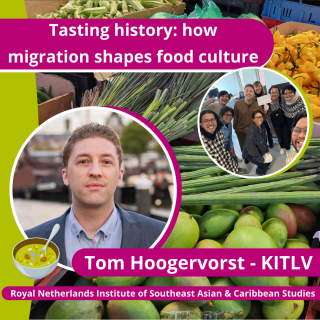
Meet the Expert | Interview with Tom Hoogervorst
Tom Hoogervorst has been part of Leiden’s academic world for 22 years, first as student and now as researcher at the KITLV (Royal Netherlands Institute of Southeast Asian and Caribbean studies. In this interview with LeidenGlobal, he discusses TASTE, the research project he is currently supervising on shifting food preferences and culinary change.
Tom Hoogervorst studied Languages and Cultures of Southeast Asia and Oceania at Leiden University, with a focus on Indonesia. As an Area Studies track, this involved learning multiple Indonesian languages and approaching the region from a range of academic disciplines. When he later moved to Oxford to pursue his doctorate in archaeology, he slowly started integrating food into his research focus. At first, he studied food items as products (particularly in the context of the spice trade), but his focus soon broadened to include how people use food and how culinary practices spread. In 2022, he was appointed as adjunct professor at the Department of Indonesian at Universitas Negeri Malang.
What appeals to him about food, he explains, is its sensory nature. “Normally, you learn about the past in two ways: through written sources or by examining human remains and the objects people have created. Food provides a missing piece of the story: what people cooked and tasted.”
The TASTE project (2024–2029) brings together Prof. Hoogervorst, three PhD students, one postdoc, three academic advisors, and numerous consultants in the field to explore what ‘taste’ is, and how food preferences and culinary practices change during and after migration. The project compares communities that once lived in (present-day) Indonesia and were later trafficked to Suriname, Sri Lanka, and South Africa. These displacements occurred at different times and for different reasons, such as enslavement or contract labour, and the project examines how these circumstances have shaped the food cultures of these communities.
According to Prof. Hoogervorst, a key finding is that diasporic food culture is shaped, simultaneously, by innovation and preservation. Dishes change due to ingredient availability or to suit locally evolved tastes, but some communities also preserve traditional techniques or recipes recorded in archives but no longer practiced in modern Indonesia.
While diasporic communities may fear the loss of cultural identity, these findings show that culinary traditions persist in diverse and meaningful ways. Variation across space does not make food ‘inauthentic’.
Food is a rich research topic because many people enjoy talking about it and attach personal meaning to it. Cuisine is closely linked to identity, and shaped by cultural, historical, social, economic, and environmental factors. Consequently, conversations about food typically reveal broader social tensions and inequalities. In Cape Town (South Africa), for example, cooking practices changed after the forced relocations under Apartheid, which cut people off from family networks and ingredients they previously relied on. Some research participants told PhD candidate Amaal Salie that they first opened up about these difficult experiences during the discussions on food as part of this research.
Precisely because food is so embedded in everyday life, culture, and identity, research projects such as TASTE can reveal overlooked historical perspectives. Tom Hoogervorst continues with the TASTE project until summer 2029. For updates, keep an eye on the KITLV website.
Interview by LeidenGlobal intern Shunita Gerritsen
January 2026
Have a look at our other experts on the Expert page